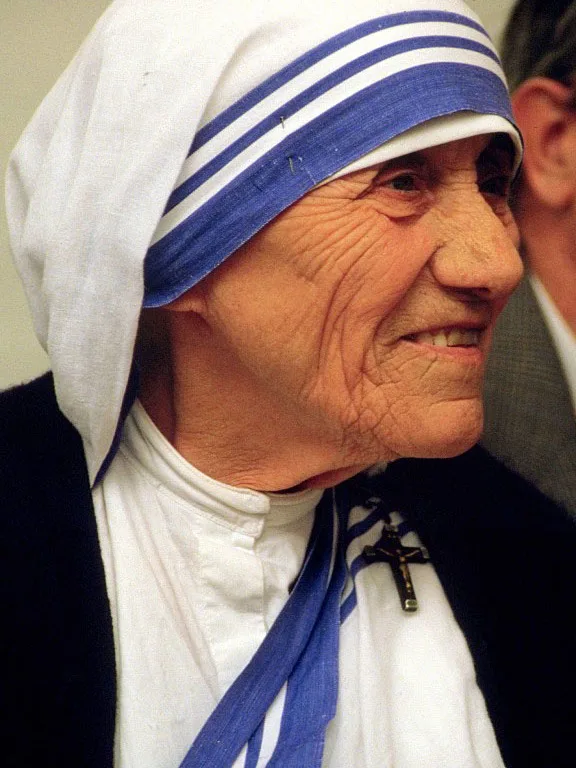
Mother Teresa
Founder of the Missionaries of Charity; Nobel Peace Prize laureate and Catholic saint
- Lived
- 87 yrs
- 1910 – 1997
- Works listed
- 0
- Career highlights
- Honours
- 4
- Most recent 1985
- Profile views
- 1
- 0 followers
Mother Teresa was an Albanian-born Catholic nun who became an Indian citizen and founded the Missionaries of Charity in Calcutta to care for the poorest of the poor. She received the Nobel Peace Prize in 1979 and the Bharat Ratna in 1980, and was canonised in 2016.
Biography
From Skopje to Calcutta
Born Anjezë Gonxhe Bojaxhiu to an Albanian family, she joined the Sisters of Loreto in Ireland at 18 and arrived in India in 1929, where she taught for nearly two decades at St Mary’s School in Calcutta. In 1946 she experienced what she called a “call within the call” to serve the poor.
Early life
Anjezë Bojaxhiu grew up in Skopje in a devout Catholic Albanian family; her father, a businessman and politician, died when she was eight. Inspired by stories of missionaries in Bengal, she left home at 18 to join the Sisters of Loreto in Rathfarnham, Ireland, learning English before sailing to India. She took her first vows in 1931, choosing the name Teresa after Thérèse of Lisieux.
Missionaries of Charity
In 1950 she founded the Missionaries of Charity, whose sisters wear the familiar white sari with blue borders. It opened Nirmal Hriday, a home for the dying, in 1952, and later homes for people with leprosy, orphans and the abandoned; it now works in more than 100 countries. She became an Indian citizen and received the Ramon Magsaysay Award (1962), the Nobel Peace Prize (1979) and the Bharat Ratna (1980).
Inner darkness
Letters published after her death revealed that for decades she experienced a profound sense of God’s absence — what she called her “darkness” — even as she continued her work. The revelation added to public fascination with her inner life.
Global reach
By her death in 1997, the Missionaries of Charity had more than 4,000 sisters running hundreds of homes, hospices, orphanages and clinics in over 100 countries. She received honours worldwide, including the US Presidential Medal of Freedom and honorary US citizenship.
Legacy and criticism
She died in Calcutta on 5 September 1997 and received a state funeral. Pope Francis canonised her as Saint Teresa of Calcutta in 2016. Critics have questioned the standard of medical care in her homes and her opposition to abortion and contraception.
Timeline
-
1910
Born in Üsküb, Ottoman Empire (now Skopje, North Macedonia)
-
1928
Joins the Sisters of Loreto in Ireland
-
1929
Arrives in India
-
1946
“Call within the call”
10 September, on a train to Darjeeling.
-
1950
Founds the Missionaries of Charity
-
1952
Opens Nirmal Hriday home for the dying
Kalighat, Calcutta.
-
1962
Ramon Magsaysay Award
-
1979
Nobel Peace Prize
-
1980
Bharat Ratna
-
1985
US Presidential Medal of Freedom
-
1997
Dies in Calcutta
-
2016
Canonised by Pope Francis
-
1997
Died, aged 87
Awards and honours
-
Ramon Magsaysay Award
1962
-
Nobel Peace Prize
1979
-
Bharat Ratna
1980
-
Presidential Medal of Freedom
1985 · United States.
Did you know?
-
1
She took her religious name after Saint Thérèse of Lisieux.
-
2
The white sari with blue borders became her order’s habit.
-
3
Her private letters revealed decades of spiritual doubt.
Gallery
Connections
Frequently asked
Who is Mother Teresa?
Mother Teresa was an Albanian-born Catholic nun who became an Indian citizen and founded the Missionaries of Charity in Calcutta to care for the poorest of the poor. She received the Nobel Peace Prize in 1979 and the Bharat Ratna in 1980, and was canonised in 2016.
When did Mother Teresa die?
Mother Teresa died on 5 September 1997 at the age of 87.
Where is Mother Teresa from?
Mother Teresa was born in Üsküb, Ottoman Empire (now Skopje, North Macedonia).
What is Mother Teresa known for?
Mother Teresa is best known for Caring for the destitute and dying in Kolkata; Nobel Peace Prize 1979.
What awards has Mother Teresa received?
Notable honours include Ramon Magsaysay Award (1962), Nobel Peace Prize (1979), Bharat Ratna (1980), Presidential Medal of Freedom (1985).
References
- Mother Teresa — Wikipedia. Wikipedia. Retrieved 26 October 2026.
- Mother Teresa — Britannica. Encyclopaedia Britannica. Retrieved 26 October 2026.
- Mother Teresa — IMDb. IMDb. Retrieved 26 October 2026.
- Mother Teresa — Nobel Prize facts. NobelPrize.org. Retrieved 26 October 2026.
- Mother Teresa — Goodreads author page. Goodreads. Retrieved 26 October 2026.
- Mother Teresa — Hindi Wikipedia. Wikipedia (Hindi). Retrieved 26 October 2026.
- Official website. motherteresa.org. Retrieved 26 October 2026.
- Mother Teresa (Q30547) — structured data. Wikidata. Retrieved 26 October 2026.
External links
About this profile
- Researched by the TrackFame editors; reviewed by Sanjay Sokal
- First published 26 October 2026
- Last updated
Cite this page
“Mother Teresa.” TrackFame, last updated 27 October 2026. https://trackfame.com/person/mother-teresa
Discussion 0
Sign in or create an account to join the discussion.
No comments yet — be the first.
More in Activism & Humanitarian
 Historical Figures
Swami Vivekananda
Hindu monk and philosopher who introduced Vedanta and Yoga to the West
1863 – 1902
 Literature
Sri Aurobindo
Philosopher, yogi, poet and early nationalist leader
1872 – 1950
 Politics & Leadership
Mahatma Gandhi
Leader of India’s independence movement and pioneer of non-violent resistance
1869 – 1948
 Historical Figures
Guru Nanak
Founder of Sikhism and the first of the ten Sikh Gurus
1469 – 1539
 Historical Figures
Ramana Maharshi
Sage of Arunachala and teacher of self-enquiry
1879 – 1950
 Politics & Leadership
B. R. Ambedkar
Principal architect of the Constitution of India and India’s first Law Minister
1891 – 1956