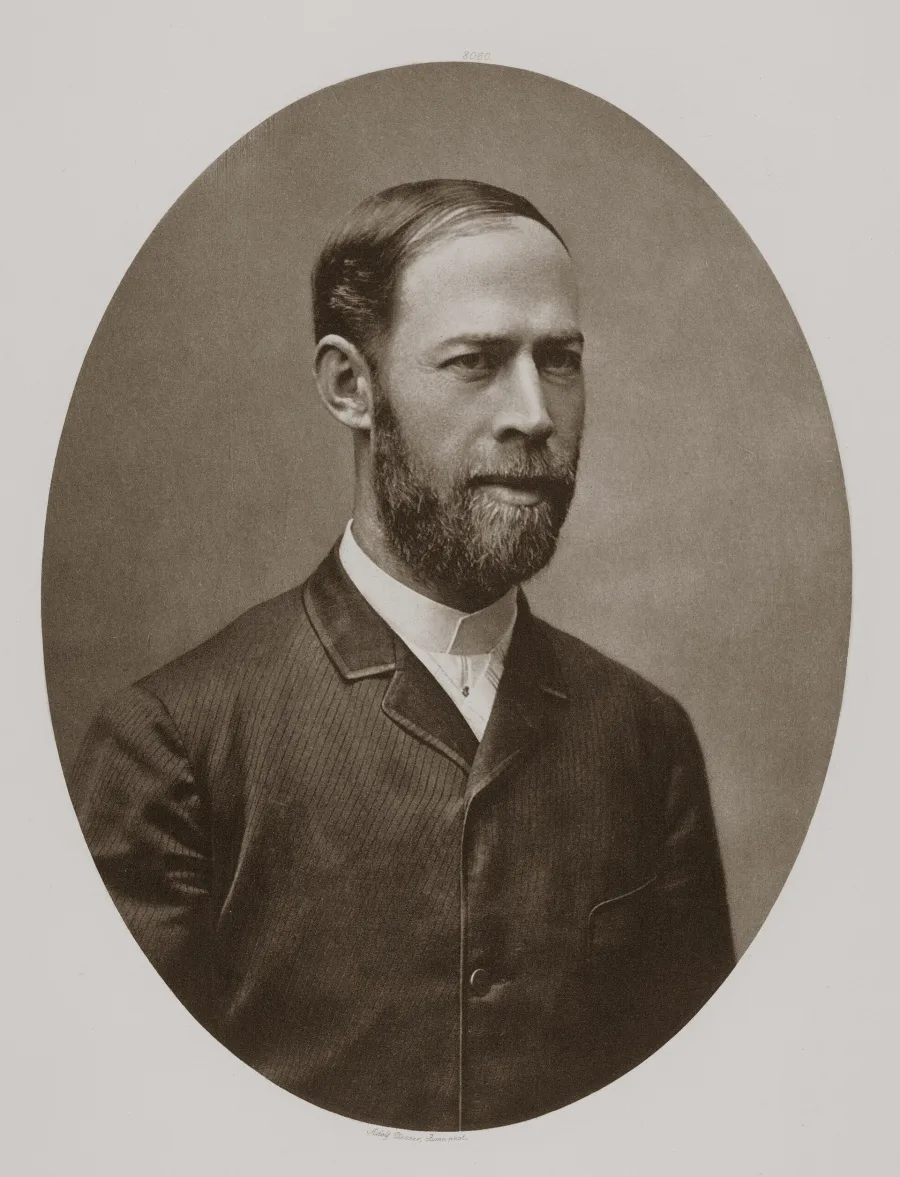
Heinrich Hertz
German physicist who first proved that radio waves exist
- Lived
- 36 yrs
- 1857 – 1894
- Works listed
- 1
- Book
- Honours
- 2
- Most recent 1890
- Profile views
- 0
- 0 followers
Heinrich Hertz was a German physicist who in 1887 conclusively proved the existence of electromagnetic waves predicted by James Clerk Maxwell. His experiments laid the groundwork for radio, television and wireless communication, and the unit of frequency, the hertz, is named after him.
Biography
Education
Hertz studied engineering and then physics in Dresden, Munich and Berlin, where he was a student of Hermann von Helmholtz. He earned his doctorate in 1880.
Radio waves
As a professor at Karlsruhe, Hertz built a spark-gap transmitter and a loop receiver in 1886–1888. He showed that the waves travelled at the speed of light and could be reflected, refracted and polarised, confirming Maxwell’s theory.
Other discoveries
He observed that ultraviolet light helps spark discharges — the photoelectric effect later explained by Einstein — and wrote on contact mechanics.
Legacy
Hertz famously thought his discovery had no practical use, but Marconi and others soon built radio on it. He died in 1894 aged 36. In 1930 the hertz was adopted as the unit of frequency.
Timeline
-
1857
Born in Hamburg, Germany
-
1880
Doctorate in Berlin
-
1885
Professor at Karlsruhe
-
1887
Demonstrates electromagnetic waves
-
1889
Professor at Bonn
-
1890
Rumford Medal
-
1894
Dies aged 36
-
1894
Died, aged 36
Notable works
-
1893
Electric Waves Book
Awards and honours
-
Matteucci Medal
1888
-
Rumford Medal
1890
Did you know?
-
1
Asked about uses for his discovery, he reportedly said “Nothing, I guess.”
-
2
His nephew Gustav Hertz won the Nobel Prize in Physics.
-
3
A Hamburg television tower is named after him.
Connections
Related people
Frequently asked
Who is Heinrich Hertz?
Heinrich Hertz was a German physicist who in 1887 conclusively proved the existence of electromagnetic waves predicted by James Clerk Maxwell. His experiments laid the groundwork for radio, television and wireless communication, and the unit of frequency, the hertz, is named after him.
When did Heinrich Hertz die?
Heinrich Hertz died on 1 January 1894 at the age of 36.
Where is Heinrich Hertz from?
Heinrich Hertz was born in Hamburg, Germany.
What is Heinrich Hertz known for?
Heinrich Hertz is best known for Proving electromagnetic waves (1887); photoelectric effect observations; the hertz unit.
What awards has Heinrich Hertz received?
Notable honours include Matteucci Medal (1888), Rumford Medal (1890).
References
- Heinrich Hertz — Wikipedia. Wikipedia. Retrieved 4 November 2026.
- Heinrich Hertz — Britannica. Encyclopaedia Britannica. Retrieved 4 November 2026.
- Heinrich Hertz — Goodreads author page. Goodreads. Retrieved 4 November 2026.
- Heinrich Hertz — Hindi Wikipedia. Wikipedia (Hindi). Retrieved 4 November 2026.
- Heinrich Hertz (Q41257) — structured data. Wikidata. Retrieved 4 November 2026.
Includes material from the Wikipedia article “Heinrich Hertz”, licensed under CC BY-SA 4.0. That text is available under the same licence. Learn more
External links
About this profile
- Researched by the TrackFame editorial team; reviewed by Sanjay Sokal under our editorial policy
- First published 4 November 2026
- Last updated
Cite this page
“Heinrich Hertz.” TrackFame, last updated 4 November 2026. https://trackfame.com/person/heinrich-hertz
Discussion 0
Sign in or create an account to join the discussion.
No comments yet — be the first.
More in Science
 Science
Frank Rosenblatt
Psychologist who invented the perceptron, an early learning neural network
1928 – 1971
 Science
Konrad Zuse
German engineer who built the first working programmable computer
1910 – 1995
 Science
Guglielmo Marconi
Italian inventor who pioneered long-distance radio and won the Nobel Prize
1874 – 1937
 Science
M. Visvesvaraya
Engineer and statesman, whose birthday is India’s Engineers’ Day
1860 – 1962
 Science
Nikola Tesla
Serbian-American inventor of the alternating-current induction motor
1856 – 1943
 Science
Alexander Graham Bell
Scottish-born inventor credited with the first practical telephone
1847 – 1922