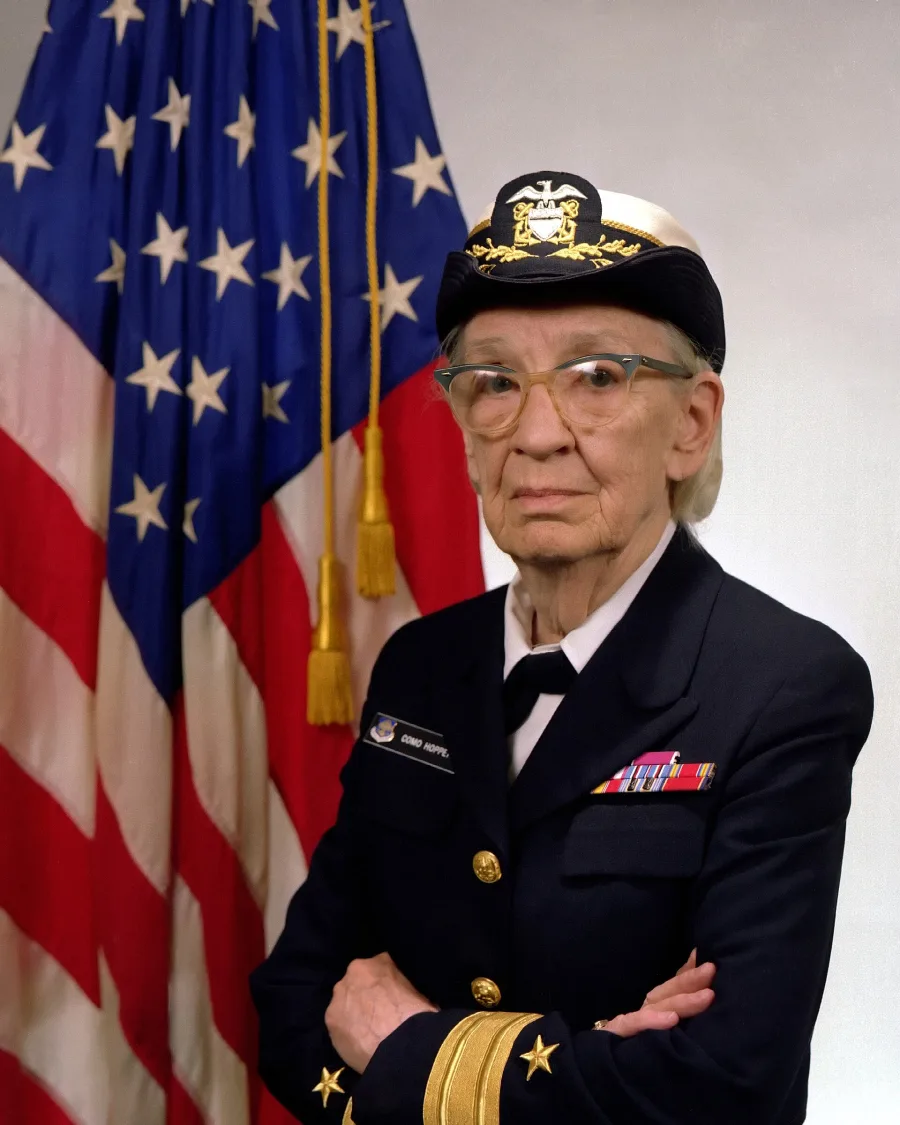
Grace Hopper
US Navy rear admiral who wrote the first compiler and helped create COBOL
- Lived
- 85 yrs
- 1906 – 1992
- Works listed
- 2
- Compiler, Programming language
- Honours
- 3
- Most recent 2016
- Profile views
- 0
- 0 followers
Grace Hopper was an American computer scientist and US Navy rear admiral. She was one of the first programmers of the Harvard Mark I, developed the first compiler in 1952 and championed machine-independent programming languages, leading to COBOL, which still runs much of the world’s banking.
Biography
Early life
Hopper studied mathematics and physics at Vassar College and earned a PhD in mathematics at Yale in 1934, one of few women to do so. She taught at Vassar before joining the US Naval Reserve in 1943.
Harvard Mark I
Assigned to Howard Aiken’s lab at Harvard, she was one of the first programmers of the Mark I computer and wrote its 500-page manual. In 1947 her team found a moth stuck in a relay of the Mark II and taped it into the logbook as the “first actual case of bug being found”.
Compilers and COBOL
At the Eckert–Mauchly company she created the A-0 compiler in 1952, translating mathematical notation into machine code, and later FLOW-MATIC, which used English-like commands. These ideas shaped COBOL (1959), a business language that became the most widely used in the world for decades.
The Navy
Hopper was recalled to the Navy to standardise its computer languages and retired in 1986, aged 79, as a rear admiral — then the oldest serving officer. She was famous for handing out 30-cm lengths of wire to show what a nanosecond is. She died in 1992 and received the Presidential Medal of Freedom posthumously in 2016.
Timeline
-
1906
Born in New York City, United States
-
1934
PhD from Yale
-
1943
Joins the US Naval Reserve
-
1944
Programmer on the Harvard Mark I
-
1947
The famous moth in the Mark II
-
1952
A-0 compiler
-
1959
COBOL designed
-
1986
Retires from the Navy
-
2016
Presidential Medal of Freedom
-
1992
Died, aged 85
Notable works
-
1952
A-0 System Compiler
-
1955
FLOW-MATIC Programming language
Awards and honours
-
Defense Distinguished Service Medal
1986
-
National Medal of Technology
1991
-
Presidential Medal of Freedom
2016
Did you know?
-
1
The destroyer USS Hopper is named after her.
-
2
Her nickname was “Amazing Grace”.
-
3
She kept a clock in her office that ran anticlockwise, to show things need not be done the usual way.
Connections
Frequently asked
Who is Grace Hopper?
Grace Hopper was an American computer scientist and US Navy rear admiral. She was one of the first programmers of the Harvard Mark I, developed the first compiler in 1952 and championed machine-independent programming languages, leading to COBOL, which still runs much of the world’s banking.
When did Grace Hopper die?
Grace Hopper died on 1 January 1992 at the age of 85.
Where is Grace Hopper from?
Grace Hopper was born in New York City, United States.
What is Grace Hopper known for?
Grace Hopper is best known for First compiler (A-0); COBOL; popularising the term “debugging”; Harvard Mark I.
What awards has Grace Hopper received?
Notable honours include Defense Distinguished Service Medal (1986), National Medal of Technology (1991), Presidential Medal of Freedom (2016).
References
- Grace Hopper — Wikipedia. Wikipedia. Retrieved 4 November 2026.
- Grace Hopper — Britannica. Encyclopaedia Britannica. Retrieved 4 November 2026.
- Grace Hopper — Goodreads author page. Goodreads. Retrieved 4 November 2026.
- Grace Hopper — Hindi Wikipedia. Wikipedia (Hindi). Retrieved 4 November 2026.
- Grace Hopper (Q11641) — structured data. Wikidata. Retrieved 4 November 2026.
Includes material from the Wikipedia article “Grace Hopper”, licensed under CC BY-SA 4.0. That text is available under the same licence. Learn more
External links
About this profile
- Researched by the TrackFame editorial team; reviewed by Sanjay Sokal under our editorial policy
- First published 4 November 2026
- Last updated
Cite this page
“Grace Hopper.” TrackFame, last updated 4 November 2026. https://trackfame.com/person/grace-hopper
Discussion 0
Sign in or create an account to join the discussion.
No comments yet — be the first.
More in Science
 Science
Charles K. Kao
“Godfather of broadband” who showed glass fibres could carry light over long distances
1933 – 2018
 Science
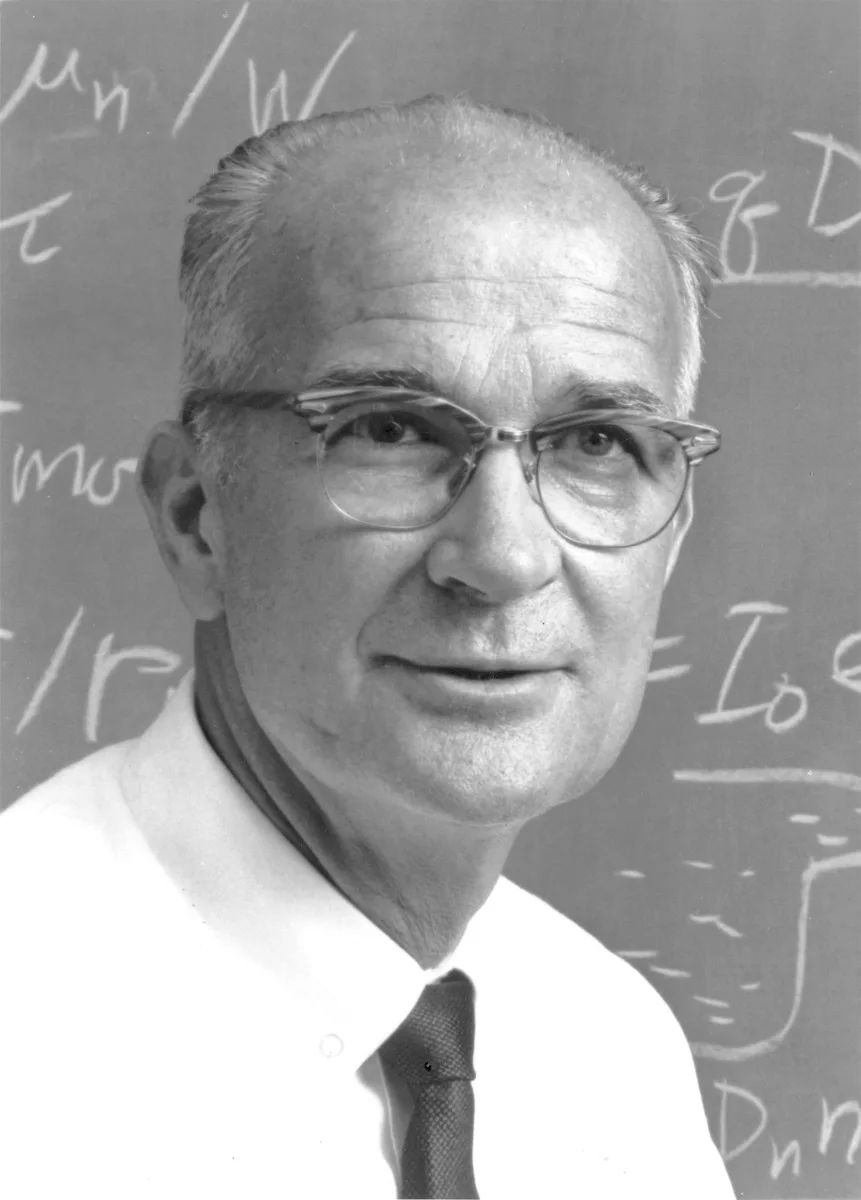
William Shockley
Nobel-winning co-inventor of the transistor who brought silicon to Silicon Valley
1910 – 1989
 Science
Charles Babbage
Victorian mathematician who designed the first programmable mechanical computer
1791 – 1871
 Science
Herbert A. Simon
Nobel-winning economist and AI pioneer who studied how people make decisions
1916 – 2001
 Science
Marvin Minsky
Co-founder of MIT’s artificial intelligence laboratory and a founding father of AI
1927 – 2016
 Science
Margaret Hamilton
MIT engineer who led the software for the Apollo Moon landings and coined “software engineering”
1936 – 2026