
C. V. Raman
Physicist; Nobel laureate who discovered the Raman effect
- Lived
- 82 yrs
- 1888 – 1970
- Works listed
- 0
- Career highlights
- Honours
- 6
- Most recent 1957
- Profile views
- 1
- 0 followers
Sir C. V. Raman was a physicist who discovered the Raman effect — the change in wavelength of light scattered by molecules — and in 1930 became the first Asian to win a Nobel Prize in the sciences. India celebrates National Science Day on the anniversary of his discovery.
Biography
Early life
A precocious student, Raman graduated from Presidency College, Madras, at 16 and published research while still a student. As there were few research posts in India, he joined the Indian Finance Department in Calcutta in 1907, doing experiments in his spare time at the Indian Association for the Cultivation of Science.
The Raman effect
In 1917 he became Palit Professor of Physics at the University of Calcutta. On 28 February 1928, with K. S. Krishnan, he observed that light scattered by a transparent substance includes light of changed wavelength — the Raman effect, now a basic tool of chemistry and materials science. He was knighted in 1929 and won the Nobel Prize in Physics in 1930.
Institution builder
In 1933 he became the first Indian director of the Indian Institute of Science in Bangalore, and in 1948 he founded the Raman Research Institute, where he worked until his death on 21 November 1970. He received the Bharat Ratna in 1954. His nephew Subrahmanyan Chandrasekhar won the Nobel Prize in Physics in 1983.
Acoustics and the colour of the sea
Before the Raman effect, Raman did pioneering work in acoustics, explaining the tones of Indian drums such as the tabla and mridangam and the physics of bowed string instruments. On a 1921 voyage to Europe he became intrigued by the deep blue of the Mediterranean; doubting the accepted explanation that it simply reflected the sky, he began the studies of light scattering that led to his great discovery.
Teacher and mentor
Raman trained a generation of Indian physicists, founded the Indian Journal of Physics (1926) and the Indian Academy of Sciences (1934), and was an outspoken advocate of science done in India by Indians. He was famously frugal with equipment, insisting that great science did not need expensive apparatus — his Nobel-winning observations used a spectrograph that cost a few hundred rupees.
Timeline
-
1888
Born in Tiruchirappalli, Madras Presidency (now Tamil Nadu)
-
1907
Joins the Indian Finance Department
Researches at IACS in his spare time.
-
1917
Palit Professor of Physics, Calcutta
-
1921
Voyage to Europe sparks his study of light scattering
-
1924
Fellow of the Royal Society
-
1926
Founds the Indian Journal of Physics
-
1928
Discovers the Raman effect
28 February, now National Science Day.
-
1930
Nobel Prize in Physics
-
1933
Director, Indian Institute of Science
-
1934
Founds the Indian Academy of Sciences
-
1948
Founds the Raman Research Institute
-
1954
Bharat Ratna
-
1970
Dies in Bangalore
21 November.
-
1970
Died, aged 82
Awards and honours
-
Fellow of the Royal Society
1924
-
Knight Bachelor
1929
-
Nobel Prize in Physics
1930
-
Hughes Medal
1930 · Royal Society.
-
Bharat Ratna
1954
-
Lenin Peace Prize
1957
Did you know?
-
1
He was the first Asian to win a Nobel Prize in a science subject.
-
2
He studied the acoustics of the tabla and mridangam.
-
3
He booked his ticket to the Nobel ceremony months before the prize was announced, so confident was he.
Gallery
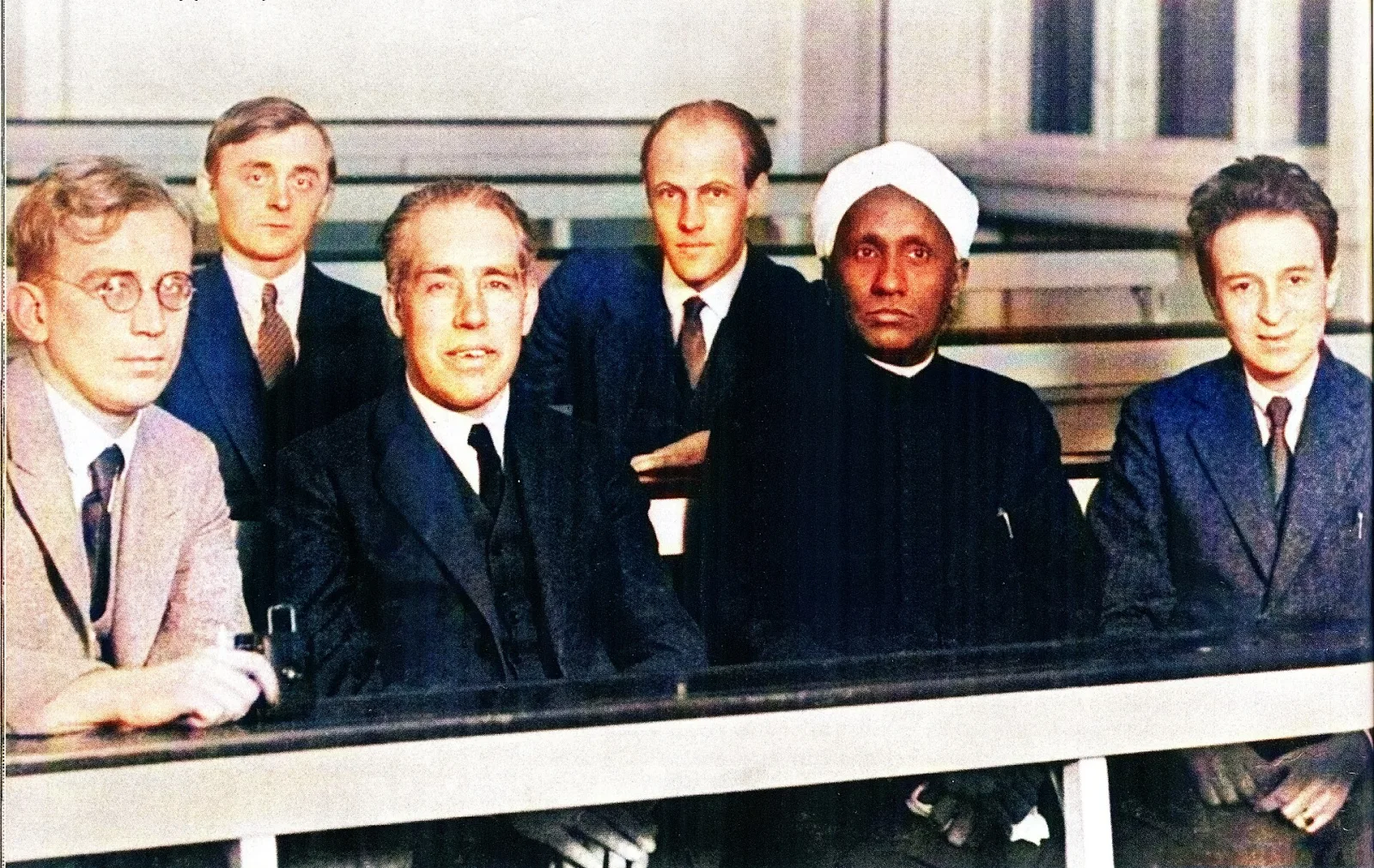
Connections
Frequently asked
Who is C. V. Raman?
Sir C. V. Raman was a physicist who discovered the Raman effect — the change in wavelength of light scattered by molecules — and in 1930 became the first Asian to win a Nobel Prize in the sciences. India celebrates National Science Day on the anniversary of his discovery.
When did C. V. Raman die?
C. V. Raman died on 21 November 1970 at the age of 82.
Where is C. V. Raman from?
C. V. Raman was born in Tiruchirappalli, Madras Presidency (now Tamil Nadu).
What is C. V. Raman known for?
C. V. Raman is best known for The Raman effect (1928); Nobel Prize in Physics (1930).
What awards has C. V. Raman received?
Notable honours include Fellow of the Royal Society (1924), Knight Bachelor (1929), Nobel Prize in Physics (1930), Hughes Medal (1930).
Who is C. V. Raman married to?
Spouse: Lokasundari Ammal.
References
- C. V. Raman — Wikipedia. Wikipedia. Retrieved 26 October 2026.
- C. V. Raman — Britannica. Encyclopaedia Britannica. Retrieved 26 October 2026.
- C. V. Raman — Nobel Prize facts. NobelPrize.org. Retrieved 26 October 2026.
- C. V. Raman — Hindi Wikipedia. Wikipedia (Hindi). Retrieved 26 October 2026.
- C. V. Raman (Q60429) — structured data. Wikidata. Retrieved 26 October 2026.
External links
About this profile
- Researched by the TrackFame editors; reviewed by Sanjay Sokal
- First published 26 October 2026
- Last updated
Cite this page
“C. V. Raman.” TrackFame, last updated 26 October 2026. https://trackfame.com/person/c-v-raman
Discussion 0
Sign in or create an account to join the discussion.
No comments yet — be the first.
More in Science
 Science
Homi J. Bhabha
Nuclear physicist and father of India’s nuclear programme
1909 – 1966
 Science
Srinivasa Ramanujan
Self-taught mathematician whose results still shape number theory
1887 – 1920
 Science
Jagadish Chandra Bose
Physicist and plant biologist; pioneer of radio and microwave research
1858 – 1937
 Science
Vikram Sarabhai
Physicist and father of India’s space programme
1919 – 1971
 Science
Satyendra Nath Bose
Physicist after whom bosons are named
1894 – 1974
 Science
A. P. J. Abdul Kalam
Aerospace scientist and 11th President of India
1931 – 2015